












Why Fragmented Workflows Feel Productive (Until They Don’t)
It’s 7:00 pm on a Thursday in late February — peak busy season. You finally lean back from your desk, stretch, and exhale. Another 12-hour day down.
Despite the long day, you feel accomplished. You spent all day updating client statuses. Moving documents between platforms. Reconciling version conflicts. Sending 47 emails.
Feels productive, doesn’t it? All that activity. But how many billable hours did you log? Zero.
That’s the problem with fragmented workflows — they don’t feel broken. They feel busy, and busyness feels productive (until you look at what you actually achieved).
The accounting industry has confused constant activity with progress and busyness with outcomes. So why do these fragmented workflows feel so productive? And what are they actually costing you?
Why Fragmentation and Busyness Feel So Productive
We’re human — we love doing what feels good. And busyness feels good. Really good. It gives us a sense of control, of progress.
Think about it: Every time you cross something off your to-do list, your brain does a little happy dance. Every email you send, every client status you update, every document you file… it gives your brain a little dopamine hit that says, “You’re so productive!”
And while, yes, you’re getting work done, your brain can’t tell the difference between admin work that fills up the day and billable hours that drive revenue. So why not just focus on the billable work?
Because fragmented workflows keep you busy enough to feel productive — without actually moving the business forward.
Activity Creates the Illusion of Productivity and Control
You don’t have to imagine Eric Green’s typical workday — you probably live it. His team spent 3-4 hours on every new client file, sending engagement agreements, collecting documents, manually uploading PDFs, and sorting files. In short, admin work.
Staff jump from platform to platform and stay busy all day. There’s constant activity. Everyone feels productive. But the hard truth is that, at $150 per hour of staff billing time, Eric’s firm was spending upwards of $600 per file on unbillable admin work.
He was paying for busyness — not outcomes. And he’s not alone: Fragmented workflows that create busyness are playing out across the industry.
When your team’s switching between apps and doing duplicate work across disconnected systems, they’re spending all day in motion. That motion feels like being in control and handling things — checking boxes, sending emails, moving files, filing.
All this activity is visible and easy to measure. 64 emails sent. 22 client statuses updated. But the measurable outcomes — the ones that drive revenue?
They’re nowhere to be found.
So we optimize for what’s visible instead. And fragmented workflows give us plenty to look at — they show activity, but not what’s moving the business forward.
Micro-Completions are Rewarding
Let’s get sciency for a minute. Research shows your brain releases dopamine when you complete a task, whether it’s trivial or meaningful. So when you update a client status, your brain triggers the same neurological reward as completing a complex tax return. Your brain celebrates both equally.
And that’s what makes fragmented workflows so enticing. They’re full of micro-completions:
- App switching
- Updating fields across four tools
- Re-uploading the same document because version control broke down
- Sending another follow-up email
Every micro-completion tells your brain, “You’re so productive. Congrats!” And who doesn’t love that feeling? Fragmented workflows amplify that feeling by hijacking the reward system with endless micro-tasks that feel just as satisfying as the real work.
These tasks matter, but the problem is that they’re replacing the work that drives revenue. You get the neurological reward without the business outcome. You feel satisfied. Your brain feels accomplished. But when you look at what you actually achieved? It doesn’t match up.
Fragmentation Covers Up the Real Problem
It’s easy to blame the chaos of tax season instead of addressing the real problem: your system.
“We’re just really busy!”
“It’s always crazy this time of year.”
“We’ll figure it out when things calm down.”
Sound familiar? These excuses let you escape the reality of your broken system.
Your disconnected workflows are fundamentally broken. You’ve normalized chaos instead of asking why it has to be this way. And most importantly, you’re treating the symptoms — busyness and activity — instead of digging deeper into the disease.
That disease? Fragmented systems that create busyness and unnecessary work.
Busyness becomes your excuse and your proof of hard work. After all, when everyone’s moving fast and in constant motion, it looks productive. When someone struggles, it feels like one more tool would fix everything.
It’s easier to add another tool to your tech stack than admit the problem is a lack of a connected workflow. It’s easier to hire more staff than admit that all that busyness is just non-billable admin work.
Fragmented workflows give you something to blame that isn’t the workflow itself. And that’s exactly what makes them so problematic.
What All That Busyness Really Gets You
Fragmented workflows do more than slow you down or create a false sense of productivity. They cost you in ways that don’t necessarily show up on a P&L statement, like errors and exhausted staff who used to love their work.
The Mental Tax
Platform switching = context switching. Context switching = productivity loss. Research backs this up, showing that chronic multitasking and context switching can consume up to 40% of productive time. Even worse? You lose 20% of cognitive capacity every time you switch gears.
Now imagine what that looks like during tax season. Staff switching between clients and apps. Spending nearly an hour a day just searching for information across tools. They’re not operating at full capacity — missing details, making errors, and operating in the wrong state of mind for detail-oriented accounting work.
But your people aren’t your problem. Your fragmented systems and workflows are. And instead of setting them up to succeed, fragmentation is creating chaos that drives employee burnout.
Errors and Rework
Is this the latest K-1? Did the client upload the updated W-2? Which platform has the current return? When documents live in multiple systems, version control becomes a costly guessing game.
Instead of doing activities that generate revenue, you spend hours reconciling, re-uploading, and re-checking what could have — and should have — been done once.
It’s not a cost that shows up on your P&L statement because it’s invisible. It just quietly inflates the cost of every single task. Wasted time. Rework. Errors that manual reviews missed. All compounding into lost productivity — and potential financial and reputational damage from incorrect filings.
You think preparing a return takes six hours. But a third of that time? You’re just fighting your own fragmented workflows.
The Busyness Burnout
The busy season is stressful because of the surge in the sheer volume of tax returns and clients. But fragmentation is what makes it utterly unbearable.
There are long hours. There’s chaos. There’s nonstop platform switching. And underneath it all, there’s never-ending low-level frustration — re-uploading docs, correcting errors, and hunting for files.
Death by a thousand tiny cuts.
Your systems fight your team every step of the way — they’re exhausted and tired of fighting back. They burn out. They leave. And it’s all because the work is hard, and your fragmented systems only amplify the stress and frustration.
What Real Productivity Looks Like
So what does real productivity feel like when you’re not fighting your systems?
It’s completed client work that doesn’t involve guessing where files live because you have a single source of truth. It’s clear version control and smart automation that eliminates the “in between” tasks. It’s teams asking, “What’s next?” instead of chasing down documents.
Sure, your team’s tired because it’s busy season. But they also know exactly what they achieved — three returns complete, two client engagements closed, and tomorrow’s workflow prepped and ready to go.
You know what real productivity isn’t?
- Constant motion but unclear progress
- Inbox cycles from full to empty to full over and over
- Bouncing between apps, dashboards, and platforms
- Asking, “Where’s the current file?” over and over
- Ending the day unsure of what you actually accomplished
Fragmentation feels busy. Real productivity feels effective.
Are You Productive or Busy?
Not sure if you’re putting on productivity theater or actually being productive? Ask yourself:
- Can any team member find any client document in under 30 seconds without asking someone else?
- Do your clients interact with one portal throughout the engagement?
- Can you see the full status of a client engagement without checking different systems?
- Is your team spending more time in tools than between tools?
If you answered “No” to any of these, you have a fragmentation problem (and the solution isn’t adding more tools).
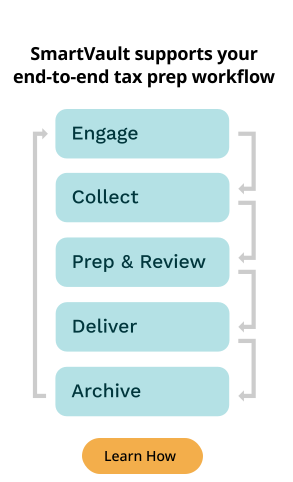
The solution? Connect your tools to create an integrated system that works with your team. When you do, your team stops drowning in admin work disguised as progress — and starts moving the business forward.
Feel Productive. Be Productive.
Fragmented systems and workflows keep you busy enough to avoid asking the hard questions — like whether all the activity is driving revenue or just motion. You manage the symptom (busyness) instead of addressing the root cause (fragmentation).
You add tools to fix the busyness, not realizing you’re just creating more symptoms to manage. What you really need? Progress. Outcomes. A connected workflow that works with your team.
Feeling productive is great — but isn’t it time your team was actually productive?
Check out our Tax Prep Workflow 2.0 ebook to see what connected workflows look like in practice and how they drive real productivity.