












Visibility Isn’t Control: Why Tax Prep Still Feels Out of Control
And yet, tax prep still feels like it could tip at any moment. You can see exactly where things are backing up — like watching traffic slow to a stop on the highway. You just can’t figure out what’s causing it.
Returns get stuck. Reviewers find themselves reconstructing work they shouldn’t have to. You realize documents are missing at the worst possible moment. Deadlines that looked manageable on Monday feel precarious by Thursday.
If you can see everything, why does it still feel like something’s always about to slip?
The Difference Between Seeing a Problem and Solving It
There’s a version of “in control“ that looks like this: you open your practice management tool, you can see all the tasks, who owns what, who’s behind or ahead. You know the status of everything. And it’s great, on the surface, because visibility tells you what’s happening.
But knowing a return has been stuck for four days doesn’t move it forward. Seeing that a document is missing doesn’t tell you where it went or who’s responsible for getting it. Your dashboard shows you the symptom, but not the cause, and it certainly doesn’t resolve it.
Where Tax Prep Actually Breaks Down
Most prep and review problems don’t start during prep and review. They start earlier — at intake, at engagement, at the moment documents were collected without a consistent structure to land in. By the time a return reaches a preparer, the damage is already done. What looks like a prep problem is usually a handoff problem.
The handoff that loses context
A preparer finishes their work and passes the return to a reviewer. The file moves hands, but the context doesn’t go with it.
The reviewer opens the return and immediately has questions. Why was this position taken? Where’s the supporting document for that deduction? What did the client say about the K-1? None of that is in the file — it’s in the preparer’s head, or in an email thread, or in a note that didn’t make it into the folder.
So the reviewer does one of two things: they track down the preparer and ask, adding delay and interruption to both of their days, or they make assumptions and move forward, which creates review risk that shouldn’t exist.
Either way, the handoff failed because the workflow was never designed to carry context forward.
The missing document that stops everything
A return is ready for review. Except one document is missing — a W-2, a K-1, something the client was supposed to provide. The reviewer flags it, the preparer reaches out to the client asking for another copy, and the return sits idle waiting for a response.
This happens constantly. What makes it a workflow problem is that the return gets set aside, while other work fills in around it. By the time the document arrives, the reviewer has moved on mentally, the preparer has to re-engage with a return they’re no longer in the flow of, and a return that should have taken two days has now taken ten.
A workflow designed around documents would have caught the gap earlier — at intake, when there was still time to resolve it before prep began. Instead it surfaces at the worst possible moment, inside the most time-constrained stage of the process.
The version problem nobody catches until it matters
It’s late in review. The return looks good… until someone notices that the workpaper doesn’t match the return. The client sent an updated document two weeks ago, a preparer saved a new version somewhere, and the reviewer was working from the original. Ouch.
Nobody did anything wrong. The system just didn’t make version clarity automatic. Now someone has to reconcile the discrepancy, figure out which version is correct, and determine whether the return needs to be reworked. What should have been a clean review turns into an investigation.
What Clarity Actually Looks Like
Real clarity during prep and review isn’t about better monitoring. It’s about a workflow designed so that the things that create confusion — missing context, lost documents, version ambiguity — don’t happen in the first place.
When every client folder is built the same way, reviewers know exactly what to expect when they open a file. When documents route automatically into the right locations, there’s no version guessing — the system tracks it. When a return moves from prep to review, the context moves with it because it was captured in the structure, not carried in someone’s head.
That shift — from monitoring problems to preventing them — is the difference between visibility and clarity.
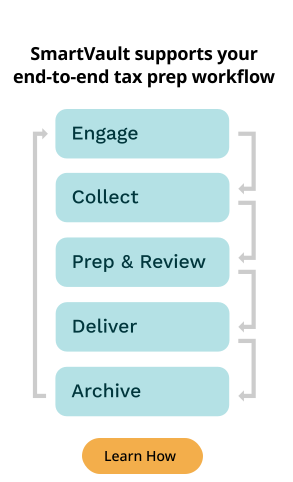
SmartVault is built to create that foundation. Client folders build automatically and consistently, so every preparer and reviewer starts from the same structure. Deep integrations with Intuit, Thomson Reuters, Drake, and Wolters Kluwer mean documents route directly into the right folders without manual transfers. Versions are tracked automatically. When work changes hands, the structure carries the context forward — so reviewers can start reviewing instead of reconstructing.
Want to see what a prep and review workflow looks like when it’s designed to hold?
Learn how SmartVault helps firms build connected workflows that move work forward without constant intervention — and read our guide on how leading firms are rebuilding their systems from the ground up.