













The Engagement Gap That Costs Firms Thousands
Fast forward to March. You’ve spent hours on unexpected Schedule C income, dealt with a multi-state filing situation that wasn’t discussed upfront, and fielded a dozen “quick questions” about estimated taxes and retirement contributions — none of which were scoped or priced.
By the time you close the file, you’ve delivered $1,500 worth of work. But the invoice still says $500 because resetting expectations now feels more awkward than just eating the cost.
This is what happens when firms treat engagement like paperwork: get the letter signed, confirm a fee, move on.
In practice, engagement does far more than kick things off. It determines whether you’ll get paid (or not) for the work you do, and it sets expectations — so clients learn what’s included, what isn’t, and how working with your firm is going to feel.
When engagement is vague, work expands in ways you don’t notice until it’s too late. Advisory starts to blend into “customer service,” and profitability erodes long before the return is filed.
Handle engagement with intention, and the dynamic changes: Clients know what they’re paying for and why, scope holds because it was anchored early, and when additional services come up, you’re not negotiating in the moment, but offering clearly defined options with clear fees attached instead.
So, despite everything that rides on it, why does engagement still get treated like a formality?
Compared to preparing returns, reviewing positions, or solving technical problems, engagement looks administrative. It happens early, before complexity shows up, and before anyone feels the pressure. It’s easy to rush through or assume you’ll “sort it out later.” The problem is that later is exactly when it’s hardest to reset expectations.
Where Engagement Breaks Down
The most common engagement mistakes don’t loudly announce themselves. They typically look like this:
You quote a fee based on last year’s return without discussing what might have changed. The client mentions they started freelancing on the side. You assume it’s minor, but of course, it turns out it’s not. By the time you realize the return requires significantly more work, you’re already deep into prep. Having a conversation about revised fees now feels harder than just finishing at the original price.
Or maybe you send a proposal that lists a fee but doesn’t break down what’s included. The client agrees. Then three months later, they’re asking for help with tax planning and estimated payments — things you never scoped or priced. You answer anyway, because saying “that’s not included” feels like bad service when you never clarified what actually was included.
None of this feels like a big deal at the time, but it creates a pattern: you do more work than you get paid for, and the client learns that “one more question” rarely costs extra.
Christine Johnson, CPA, saw this play out every season. “I was giving away so much knowledge upfront without getting paid,” she said. This free work included follow-up questions, expanded scopes, and advisory conversations outside any formal agreement. Her to-do list grew quickly — to the point she was swamped throughout the entire year, giving away significant expertise for free.
After she started using SmartPath Engage, that dynamic shifted. Clients could see exactly what was included in their base engagement, what wasn’t, and what additional services were available. Scope wasn’t ambiguous anymore — it was defined, transparent, and easy to reference.
Why Scope Creep Happens During Engagement
One of the biggest profitability drains shows up in the dozens of small moments when you say yes to work you never scoped or priced.
A client emails in February: “Quick question about estimated taxes.” You spend twenty minutes answering. Then two weeks later the same client asks: “Should I contribute more to my SEP?” There’s another thirty minutes of your time. Then it happens in March: “Can you explain this 1099-K?” Another forty-five minutes unpaid spent on that question.
By April, you’ve given away hours of advisory work — work the client values and would pay for if presented as a service — but because it came through casual requests, it never got billed.
This happens because engagement never made clear what was included. The scope was too vague. A defined scope — “Your engagement includes return preparation and two rounds of review. Estimated tax planning and quarterly consultations are available as add-ons.” — eliminates the ambiguity.
What Clients Expect from Engagement Now
A few years ago, engagement was slow but predictable. You mailed a letter. The client signed it. They mailed it back. Nobody expected instant clarity.
That’s not how it works anymore. People expect clarity from the beginning. They’re asking questions:
- What am I actually paying for?
- What’s included and what isn’t?
- What happens if my situation gets more complicated?
- And what do I do first?
For clients to feel confident about your services, you need to answer those questions upfront. If you don’t, they’ll either ask constant questions — hello, unpaid work — or stay quiet and feel confused — goodbye, referrals — throughout your engagement.
How to Make Engagement Clear
Most firms use tools — email, PDFs, spreadsheets — that weren’t built to make pricing, scope, and expectations visible and enforceable. That’s where tools like SmartPath Engage come in.
It gives firms a way to present pricing clearly, define scope explicitly, and onboard clients through one system clients actually understand.
Pricing Clarity That Clients Can See
Instead of emailing a fee with no context, firms can present options — often as tiered packages (basic tax prep, tax prep + advisory, comprehensive planning) — so clients see what’s available and choose what fits. On your side, you don’t have to worry about sales conversations, and there’s no question about scope or what happens when something falls outside of it. Everyone is aligned from the very beginning.
Scope That’s Defined, Not Implied
Pricing connects directly to services, so scope isn’t negotiable after the fact. The client knows what they’re getting, and you know exactly what you’re delivering. If the client needs something outside that scope — quarterly planning, an amended return, whatever — you’re not negotiating. Instead, you’re offering an additional service with a clear fee.
Onboarding That Doesn’t Require Follow-Up
Once a client selects their engagement, they move into a secure dashboard where they complete next steps — review terms, answer questions, make payments.
There are no more email threads to track or confusion about what to do next. The system guides them, and you can see where each client is in the process.
The Result: Clients Choose Higher-Value Services
When clients understand what they’re paying for and why it matters, they’re more likely to choose higher-value services and stay engaged year-round.
Michael McGovern, EA, saw this firsthand. Within a year, 70% of his firm’s fees became recurring. Clients weren’t just signing up for one-off tax prep. They were opting into year-round advisory — services they could see, understand, and choose confidently because the value was clear from the start.
Where Documents Come In
Even when engagement is designed well — pricing clear, scope defined, onboarding professional — there’s one more place firms stumble: the handoff from engagement into client intake and tax prep.
The client signs the engagement, chooses their package, completes onboarding. Then they ask: “Where do I send my documents?”
If the answer involves multiple systems or reverting to email, the clarity you built during engagement starts to unravel. Engagement sets the structure for pricing and scope, but without a system of record, even the best engagement design eventually falls apart.
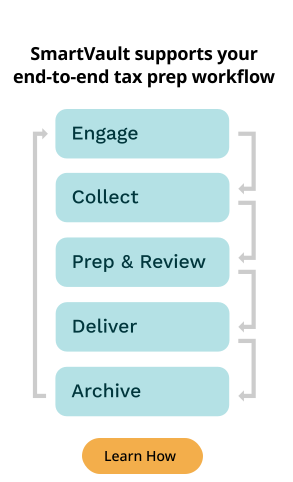
That’s where SmartVault comes in. Everything from engagement through archive ties to the same client, year, and engagement you just designed. From AI-powered intake that creates custom questionnaires and auto-compiles workpapers, to providing a single source of truth throughout the engagement and beyond — scope, pricing, and deliverables stay visible and connected as the work moves through your entire tax prep workflow.
When Engagement Works
Things just stop slipping through the cracks.
Clients understand value. They know what they’re paying for and why it matters. That clarity builds confidence and makes them more likely to choose higher-value services and refer others.
Scope holds. Expectations were set early and tied to specific deliverables, so additional requests don’t automatically become unbilled work.
Profitability improves. You get paid for the work you do, and advisory doesn’t get disguised as “customer service” anymore. Services that should be billed separately get offered as options, not absorbed as accommodations.