










If Client Intake is Automated, Why Does It Still Take Hours?
Your client shares their source documents and exhales — “Cool. I did my part,” they think as they shut down for the night.
The work is officially in your hands. But before your team can start the return, someone has to figure out where everything landed.
The engagement letter lives in the eSignature tool. Source documents are split between the portal and email. Last year’s workpaper sits on someone’s hard drive. Questionnaire responses are in a separate intake system.
Nothing is technically missing, but you definitely can’t get straight to work.
That gap — between documents collected and documents ready to work from — is where 60-90 minutes per return disappears.
Most firms tried to fix this by getting clients to upload faster, though speed was never the bottleneck.
Documents may arrive sooner now, but if the workflow wasn’t designed to carry them forward, all you’ve done is move the work somewhere else.
When Faster Collection Makes Everything Worse
Intake used to be painfully slow but predictable. Clients snail-mailed documents or dropped off manila envelopes at your office. You filed them into the right folder, and everyone knew where things lived — in that trusted filing cabinet.
Obviously, that’s not how things are anymore. Today, everything’s accelerated by cloud-based platforms, AI tools, mobile apps, you name it.
Speed. That’s been the goal for the last decade. How can we make this faster? And look, that’s a reasonable question. Who wouldn’t want to get the most painful part of tax prep over with?
But speed only helps when the system knows what to do with the documents and information that arrive.
When a client uploads eight documents through an email thread or generic portal, those files land in a temporary holding space — not in the client’s folder, not connected to their engagement, not tied to the workpapers that will support their return.
Before any tax thinking can happen, someone has to consolidate everything. What looks like a few quick steps — downloading files, organizing folders, confirming what’s actually there — quietly becomes hours of work multiplied across your entire firm.
Eric Green’s firm put numbers behind that hidden work. His team spent 3-4 hours per new client sending agreements, collecting documents, and sorting through PDFs that were often 200 to 300 pages long. At $150 per hour, that translated to $450-$600 per client in unbillable administrative work.
Now with SmartVault, clients upload files directly into organized folders through the secure portal. The result: Eric’s firm reclaimed approximately $150,000 annually — time they redirect to revenue-generating client work instead of administrative cleanup.
What the Firms That Fixed Intake Chaos Realized
The firms that eliminated intake chaos realized the problem wasn’t speed. It was fragmentation — each stage of the workflow treated as its own component, with documents manually transferred at every handoff.
So they redesigned the system.
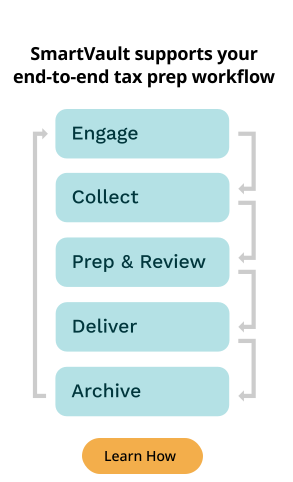
Instead of optimizing intake in isolation, they built a connected workflow where all documents — from engagement through archive — live in one secure infrastructure.
SmartVault is that system of record. Engagement materials, source documents, questionnaire responses, workpapers, signed returns, and archived records remain tied to the client, year, and engagement inside one secure environment.
And because SmartVault integrates deeply with Intuit®, Thomson Reuters®, Drake®, and Wolters Kluwer®, documents move seamlessly through the tax prep process without being manually transferred at every handoff.
Within that connected foundation, AI tools like SmartRequestAI can do what they’re meant to do — analyze prior-year 1040s, generate personalized document requests, route uploads into structured folders, and produce prep-ready workpapers — because they’re operating inside one system, not layered on top of disconnected ones.
Without a system of record, firms rely on people to connect the pieces — downloading files, moving them between systems, reconstructing context at every stage. With one, the structure carries forward automatically.
Schedule a demo to see how SmartVault can work at your firm.