












The Growth Ceiling Most Tax Firms Don’t See Coming
Because the work gets done, there’s no urgency to change anything.
That’s the trap: things are just good enough. But “good enough” usually means the same thing in most firms: too many fragmented tools that don’t talk to each other, with people filling the gaps in between.
The problem with fragmented workflows is that they make the work cost more than it should — in time, in money, in people — without ever triggering an alarm. They create a ceiling that most firms don’t notice until it’s right there.
What Fragmentation is Actually Costing You
Most of the time, these costs don’t announce themselves. They show up in the aggregate — a team that’s perpetually behind, a firm that can’t seem to grow past a certain point, a busy season that somehow gets harder every year despite everyone working just as hard. Here’s what’s actually driving that.
Time and revenue you’ll never get back
Every return that moves through a fragmented workflow carries hidden overhead. A document lands in the wrong place — someone has to find it. A client sends files to three different email addresses — someone has to consolidate them. A preparer finishes their work and passes it to a reviewer who has to reconstruct what happened before they can start — because the context didn’t transfer, only the file did.
None of these moments feel catastrophic — each one is just a few minutes of work. But across hundreds of returns, across an entire tax season, those minutes compound into weeks of capacity your team never got to use for actual tax work.
And that’s before you account for the revenue that never gets captured — the scope that drifted because there was no system anchoring it, the services that got delivered but never billed because the engagement wasn’t set up to track them.
Security exposure that’s easy to overlook
Fragmented workflows create fragmented data. When documents live across email threads, shared drives, local folders, and disconnected tools, your security posture becomes nearly impossible to manage consistently. Permissions drift, retention rules go unenforced, and nobody has a complete picture of where client data actually lives.
The FTC Safeguards Rule requires firms to protect client financial data — and regulators don’t distinguish between an intentional breach and a preventable oversight. The average cost of a data breach has climbed to $4.88 million, but for an accounting firm, the more immediate damage is the loss of client trust that can’t be recovered with an apology.
The staff problem nobody talks about openly
Burnout in accounting gets blamed on busy season: on the volume of work, the deadlines, the long hours. Those things are real. But a significant part of what makes busy season brutal is the workflow fighting the team at every step.
When skilled professionals spend their days chasing documents, reconstructing context, fixing filing errors, and waiting on information that should already be in front of them, the job starts to feel unmanageable.
Everyone knows tax season is hard work. Hard work is something good people sign up for. Unmanageable work? Well, that’s something they leave.
The growth ceiling you can’t see until you hit it
Here’s where “it works well enough” becomes most dangerous.
A workflow held together by a few key people and a lot of manual coordination can absolutely handle 200 clients. It might even handle 300. But at some point — when you try to bring on new staff, when you want to take on more clients, when you want to step back from the day-to-day — the seams start to show.
New staff can’t onboard quickly because the workflow lives in people’s heads, not in the system. Delegation breaks down because there’s no consistent structure for work to move through. You can’t step back because the firm depends on you to hold it together.
The growth ceiling isn’t visible until you try to push through, and you suddenly realize the workflow is pushing back.
What Changes When the Workflow is Built to Hold
The costs described above often accumulate slowly, quietly, in ways that feel like normal business friction — until you look up one day and realize the firm isn’t growing the way it should, the team is more tired than the workload justifies, and you’re still the one holding everything together after all these years.
When documents move through a connected workflow — routed automatically, organized consistently, accessible without anyone having to track them down — the hidden costs stop compounding.
- Time that went into finding files goes back into tax work.
- Security gaps close because data lives in one system with consistent controls.
- Staff do the work they were hired to do instead of managing the friction around it.
- And growth stops being limited by how much you can personally coordinate.
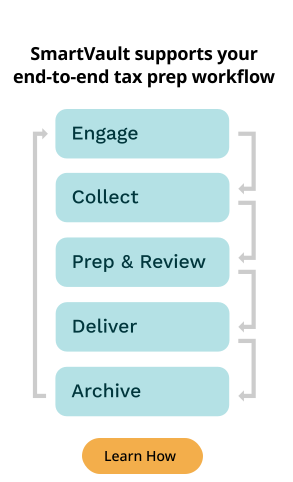
SmartVault is built to be that foundation — a true document management system and system of record where engagement letters, source documents, workpapers, signed returns, and archived files all live, connected to your tax software and organized from the start.
With workflow tools like SmartRequestAI, intake doesn’t live in email threads or generic portals. Clients receive structured document requests based on prior-year returns, uploads route automatically into organized folders, and prep-ready workpapers are generated without manual consolidation. Instead of piecing stages together, the workflow moves as one connected system. It’s the structure that makes the rest of the workflow hold together instead of relying on people to do it manually.
Want to see what this looks like in real life? Learn how SmartVault creates connected tax workflows that work without constant intervention — and read our guide on how leading firms are rebuilding their systems from the ground up.