






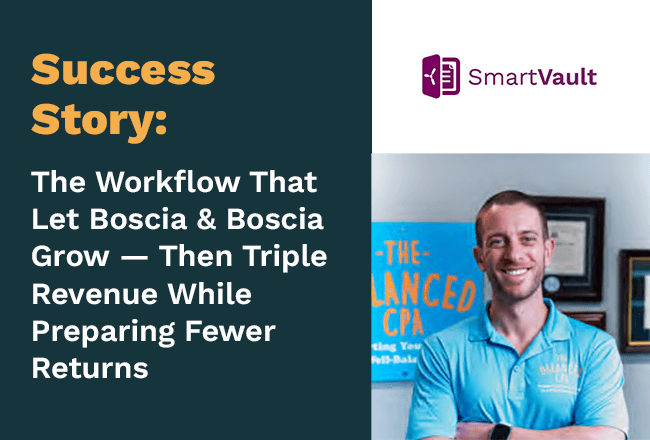
The Workflow That Let Boscia & Boscia Grow — Then Triple Revenue While Preparing Fewer Returns
Nick Boscia can still describe the folders. Big red ones with green sheets for business clients, plain manila ones for individuals, stacked in filing cabinets that lined the office his father had run since 1975. When Nick joined Boscia & Boscia in 2013 — a fresh CPA license and a year at PwC behind him — this was the workflow he inherited: every client’s paperwork filed by hand, with every return built from documents that arrived by mail, drop-off, or email, whenever a client got around to it. The firm’s biggest investment in technology was its tax software, Intuit Lacerte, which the Boscias had adopted so early that Nick jokes they were among its first users.
It wasn’t broken, exactly. His father had earned a loyal client base running the firm this way for decades. But nearly every part of the workflow involved a physical transfer of effort — whether from clients dropping off shoeboxes overflowing with receipts, or from staff entering data line by tedious line.
“We kept adding more clients, but all that meant was more hours, more stress, and less time for anything else,” Nick says. The workflow reached its natural limit.
For Nick, who also founded TheBalancedCPA to help other professionals build businesses without sacrificing their personal lives, the choice eventually became unavoidable. If he wanted a firm that could grow without consuming its team — and still run when he took a vacation — the workflow had to change.
Building the Foundation Before the Growth
When Nick had room to modernize the firm, he didn’t attempt a sweeping overhaul. He started with the most persistent pain point: paper.
SmartVault was the first piece of technology Nick brought into the firm. It gave clients a secure portal to upload documents instead of dropping off paper or emailing sensitive files, and it integrated directly with Lacerte, so a completed return filed automatically into the right client folder without anyone touching it.
Folders built themselves too, automatically, based on engagement type and tax year, which meant the same structure existed across every client the firm had — nobody, client or staff, ever had to wonder where something lived. It was a far cry from the years of red folders and green sheets. “All of the problems we had with the paper and filing cabinets disappeared when we moved to SmartVault,” Nick says.
Adoption was gradual at first, with some clients embracing it right away and others, as Nick puts it, reluctant to change a process that had worked fine for forty years. Then COVID hit, and firms across the country scrambled to figure out how to collect documents from clients they could no longer meet in person. Boscia & Boscia already had the infrastructure in place, and client adoption of the portal jumped dramatically that year — what had been a nice-to-have became, almost overnight, the standard way the firm operated.
The result was a return volume that roughly doubled, from around 700 to over 1,800 tax returns a year, without a proportional increase in administrative work. It also gave Nick something he hadn’t had before: the ability to take a real vacation and trust the firm would still be running when he got back.
It also opened up geography that used to be off-limits. Without a filing cabinet anchoring the business to one office, the firm stopped being confined to New York, New Jersey, Pennsylvania, and Connecticut, and started taking on clients from all over the country.
Turning a Portal Into a Client Standard
SmartVault has become the firm’s standard method for exchanging documents with clients. Every new client starts by uploading their prior year’s tax return to SmartVault. Nick reviews it before the first call, and if they decide to work together, everything follows the same process from there.
“Our workflow literally starts with SmartVault,” Nick says. “SmartVault is our central hub with our clients.“
That consistency reduces internal work, but its value is just as visible to clients. A business owner with several companies can log in once and see every entity. A client applying for a mortgage doesn’t have to wait for the office to locate and mail three years of returns — the documents are already there, secure and ready.
When “More” Stopped Being the Goal
For years, the firm’s growing return volume was the scoreboard. Every new engagement seemed to confirm the model was working. But once the firm reached its peak, Nick realized a full workload wasn’t necessarily the same thing as a healthy practice. Growth had opened the door to more work; now he could be more thoughtful about which of it he wanted.
Each year, the team reviews its client list and identifies the relationships that create the most friction — clients who are routinely disrespectful, unresponsive, late, or resistant to how the firm operates. Those clients may be fired. Clearing away the relationships that drain the team’s time creates more room for the clients who value how the firm works.
The number of tax returns the firm prepares has come down from a peak of 1,800 to roughly 1,400. Revenue, meanwhile, has tripled since Nick joined the firm in 2013 — a gain built over the firm’s full transformation, not just the more recent pullback in return volume.
The goal today isn’t to prepare the largest possible number of returns. It’s to build deeper relationships with clients who want a modern experience and are willing to pay for the expertise behind it. The efficiencies SmartVault created gave the firm the capacity to offer paid tax planning and advisory services it couldn’t easily provide before: whether to convert to an S corp, whether to put a spouse or kids on payroll, whether it makes sense to expand.
“The clients who like using our technology love working with me because we’ve gotten rid of all the administrative stuff that we don’t need to do,” Nick says. “I have more time for actually talking on a video call and giving advisory.“
Changing Tax Software Without Changing the Experience
This year, Boscia & Boscia made its second major technology decision: moving its tax preparation software from Intuit Lacerte to the cloud-based Intuit ProConnect.
Nick had considered the move for years, but held to one condition — he wouldn’t switch until SmartVault’s native ProConnect integration was ready, because the firm’s workflow depended on SmartVault.
Once that integration was in place, the transition was far less disruptive than a major software change might sound. In fact, the core process stayed the same. For clients, the change was almost invisible. For the firm, as Nick describes it, the experience simply amounted to a new login. Folder structures, document routing, the portal experience: none of it changed. Lacerte and ProConnect run on the same underlying engine, but now Nick’s firm is fully in the cloud.
Growth That Creates Options
The firm grew from around 700 tax returns a year to a peak of 1,800, deliberately brought that number back down to around 1,400, and tripled its revenue along the way.
The more meaningful part of the story sits beneath those figures. Boscia & Boscia was already a successful firm before Nick changed anything. His father had built a loyal client base and kept the business thriving for decades. Nick was never trying to prove the old way had failed, or that his way was better.
He looked honestly at what the firm had been, imagined what it could become, and improved it one process at a time. First, that meant creating room to grow. Later, it meant redefining what growth looked like.